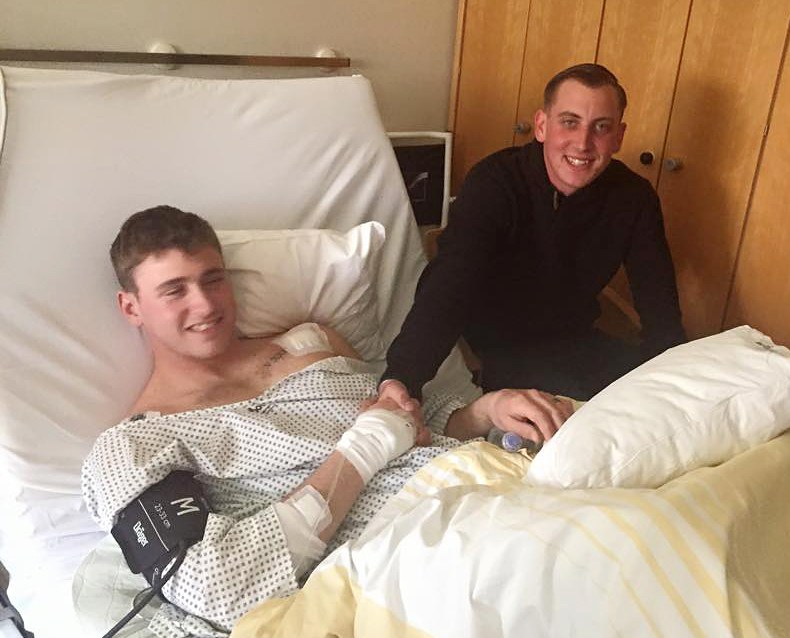
But that’s a minor mystery compared to what happened next: After receiving CPR from a fellow soldier and getting zapped six times by a defibrillator at a nearby aid station, Spc. Clint Lopez’s heart re-started, and he began breathing on his own.
Army medical staff put Lopez in a coma to improve his recovery odds. They brought him out less than two days after the collapse, and aside from initial mobility problems with his left arm and minor short-term memory issues, Lopez rocketed back to health.
Doctors would later tell his mother that he’d gone about 30 minutes without a heartbeat, and for at least 10 of those minutes, he didn’t get any oxygen.
He’s since flown back to the states and been discharged from San Antonio’s Brooke Army Medical Center, though he’s still undergoing evaluations for traumatic brain injury and other potential concerns, he said in an interview late last month.
“I have a treadmill test coming up this week,” Lopez said. “If everything goes good, I can start doing PT again.”
Lopez, married with a 1-year-old son, has no memory of the last time he went out for a run. Spc. Ryan Kellogg does.
Collapse, CPR and the car
Kellogg, serving with Lopez in Bravo Company, 1st Battalion, 4th Infantry Division, in Hohenfels, Germany, recalled being on the two-mile Army Physical Fitness Test course a little after 7 a.m. on April 10. Shortly past the halfway mark, he said, “I was running and I proceeded to look up and I saw a soldier, I didn’t know who it was at the time, down on the ground.”
He flagged down a car, grabbed Lopez under the armpits and hauled himself and his patient into the back seat. The sedan headed toward a nearby clinic, and Kellogg checked Lopez’s vitals once more.
“There was no pulse,” Kellogg remembered. “His eyes were open, and he was looking down at the ground.”
In the back of a moving car, Kellogg began compressing Lopez’s chest and breathing into his mouth. Then, a new wrinkle: The clinic was closed. Kellogg told the driver to head for 1-4’s aid station, and just before the car arrived, Lopez gasped briefly for air.
“I got him in front of the aid station, and there was a formation going on,” Kellogg said. “I yelled for a medic and I proceeded to drag [him] into the aid station, where the medics took over.”
The car ride went about three miles, Kellogg said. Medics set to work with the defibrillator, and soon, word would reach Lopez’s family.
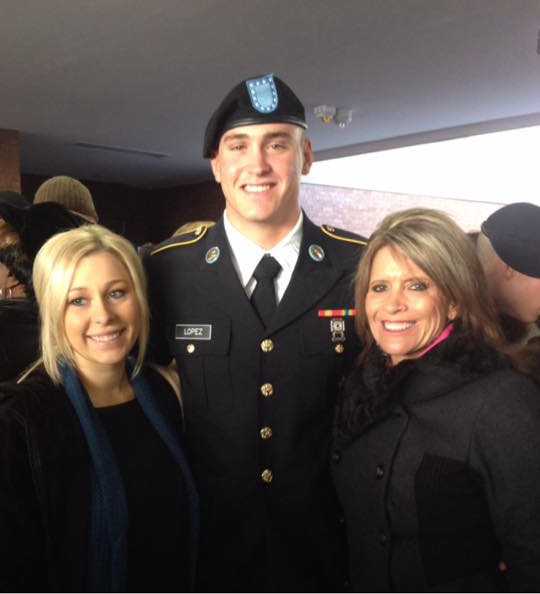
Spc. Clint Lopez, center, poses with wife Michaela and mom Penny in 2013.
Photo Credit: courtesy of Penny Lopez-VanGombos
‘His last experience was death’
Maybe it was the time of day, or the uncertainty on both ends of the phone line, but Lopez’s mother, Penny Lopez-VanGombos, wasn’t sure what to make of her talk with his wife, Michaela, in the hours after the incident.
In Oklahoma, around 3 a.m., Lopez-VanGombos eventually spoke with a sergeant at Michaela’s side.
“I just need to ask one specific question,” she recalled saying. “Do I need to get there?”
“And he said, ‘As quick as you can.’ “
One emergency passport renewal later, she was en route to Germany, where she arrived shortly before her son was removed from the medically induced coma.
“They basically told me that when he came out, he would be afraid, panicked, because his last experience was death,” she said. “That’s if he came out, of course.”
Lopez, having already defied medical expectations, came to within minutes and was calm and alert, his mother recalled.
He was in intensive care for a week. Doctors implanted a pacemaker/defibrillator into his chest — “It’s supposed to be top of the line,” Lopez said. His oxygen-deprived brain slowly unscrambled, though for a time he thought he was back in high school and his short-term recall was all but shot.
“For a while, the one thing that seemed to stick was, ‘I died,’ ” Lopez-VanGombos said.
His memory improved dramatically after some time in San Antonio, though his mother always will remember her son’s miraculous arrival — about two weeks after he’d “died” an ocean away.
“He got out of the ambulance in uniform, walked in in uniform, and they had his luggage on the gurney,” she said. “It was just amazing.”
Lopez’s heart implant and still-mysterious medical issues will force him out of service, his family said. He plans to attend college and “get on with my life,” he said, and supporters have set up a fund to assist the family in covering any ancillary expenses associated with that new start.
He keeps in touch with friends in Germany via Facebook, talking with Kellogg at least once a day. Kellogg’s rapid reaction wasn’t the only thing moving fast on April 10: The Army awarded him and three medical-team members who treated Lopez — Spc. Christopher Castillo, Sgt. Nicholaus Moore and Sgt. Brandon Wood — with Army Commendation Medals before the day was over.
“I’ve gotten to talk to most all the guys [from the unit],” Lopez said. “I was just thankful for [Kellogg] being there. The other guys, I’m just trying to catch up, seeing if I missed anything.”