Shoot. Move. Communicate. Think.
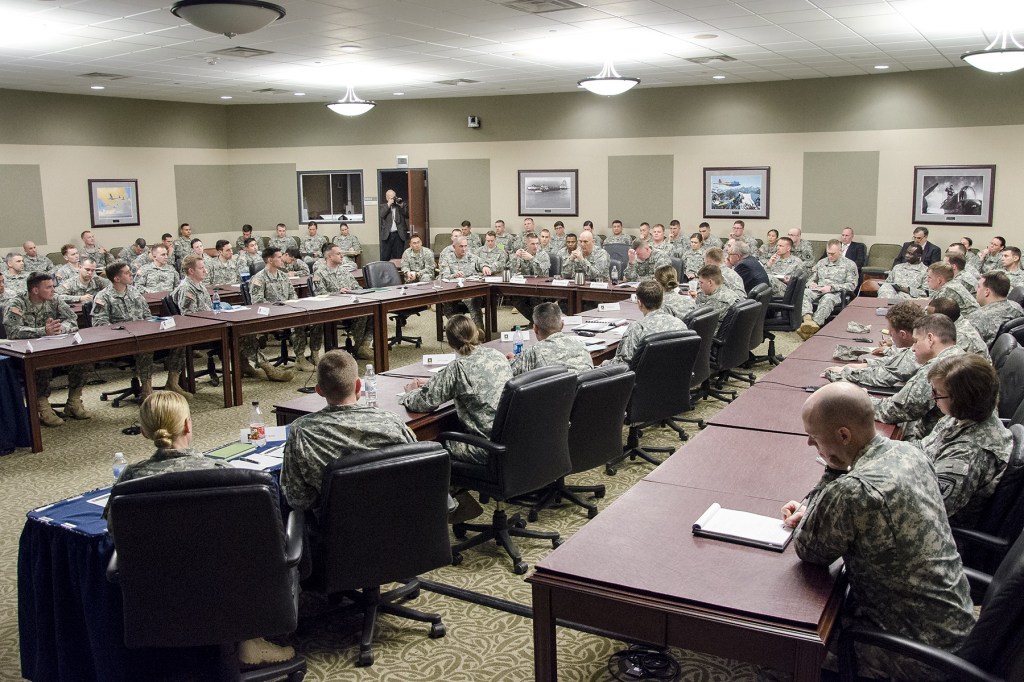
Broken into groups and guided by the Army Operating Concept, the captains offered suggestions ranging from increased joint operations at lower levels, as a way to expand a soldiers’ knowledge base, to standardized assessments of problem-solving skills. They proposed streamlined training, better measurement of cognitive abilities, even a system that would track soldiers’ performance and potential using advanced metrics: “‘Moneyball’ for the Army,” one presentation slide called it.
It was the second meeting of the Solarium group for such a project, and they again had an attentive audience.
“It is informative for me to listen, learn and engage with professional leaders who care about the Army and the joint force,” Odierno said in a statement after the meeting. “Their feedback and insights are invaluable and meaningful. Dialogue such as this creates a strong intellectual foundation for our future Army.”
Get smart
While the Solarium looked toward the future, captains were informed by the problems of the present.
“As we get smaller, we have to retain the right folks and get them thinking, early and often,” said Capt. Cisco Fuller, who serves with TACOM Lifecycle Management Command in Warren, Michigan. “Increased emphasis on critical thinking should come [at] as early of a stage as possible.”
Such a focus would help the Army achieve its goal of leader flexibility — soldiers who can adapt tactics to take advantage of multiple resources and defeat a range of enemies. Fuller’s group suggested other ways to expand that leader skill set, including short-term assignments or internships with other agencies, and more work with other military branches, local law enforcement, and guard and reserve units at all levels.
Another group proposed making some level of “cross-cultural understanding” a commissioning requirement, underscoring the need for that type of experience in a variety of missions, such as dealing with an insurgent threat or providing humanitarian aid. Another proposed a one-stop online training setup similar to Amazon, where soldiers or instructors could search for best practices or other learning tools and receive recommendations for related topics.
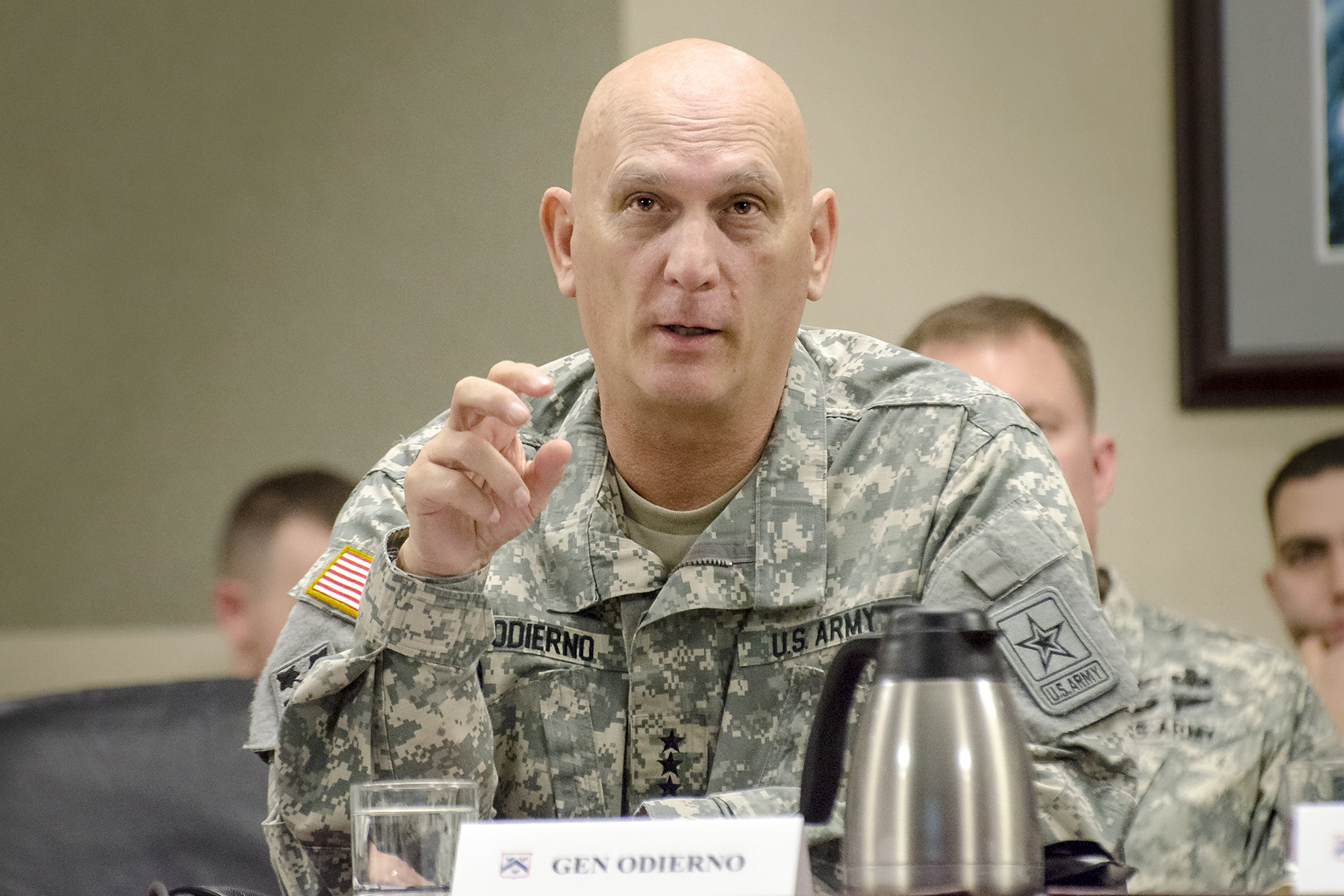
Army Chief of Staff Gen. Ray Odierno addresses participants in the Solarium 2015 conference at Fort Leavenworth, Kansas, late last month.
Photo Credit: Dan Neal/Army
Developing the brainpower and cultural knowledge is one thing, but the captains also proposed ways to keep track of such understanding.
“An easy way to find out if we’re plateauing, or getting better, at a skill is to find a way to measure it,” said Capt. Gary Klein, one of three captains in this year’s Solarium that did not participate in the 2014 event.
Klein’s group suggested a standardized assessment of advanced cognitive abilities, allowing the force to track these attributes in a similar, but more complex, way that GT or Armed Services Vocational Aptitude Battery test scores are used.
Such a system would allow units to tailor their critical-thinking training to the needs of their members, and move the training farther down the ranks.
“In today’s world, there’s a lot more pressure … at the lowest level,” said Klein, a troop senior observer-coach-reporter with the operations group at the Joint Readiness Training Center in Fort Polk, Louisiana. “Soldiers at the lowest level can’t necessarily wait for leaders to make decisions for them. … They have to be able to operate in a more decentralized manner.”
Get … ‘Moneyball’?
Another group took assessment to the next level, suggesting the Army implement a “Total Soldier Concept” that would rate each soldier’s mental and physical skills, as well as personality traits, and use those stats to better inform decisions on retention and assignment.
Presenters drew comparisons to “Moneyball,” a book by Oakland A’s general manager Billy Beane on how he built contending teams on one of baseball’s smallest budgets by relying on advanced statistical analysis — “sabermetric” skills now used throughout the sports world.
Similar analytical tools are in use by the Mayo Clinic to rank surgeons, according to a presenter, and the Army’s large talent pool — and high rate of turnover — make it an ideal setting for such advanced analysis.
“There’s been a lot of discussion, both at this this Solarium and the previous Solarium, about talent management, and what we’re doing to make sure we have the right people in the right jobs at the right time,” group member Capt. Sindi Connell said. “Data [could be] used to help drive that.”
Connell, an instructor at the Military Intelligence Captains Career Course at Fort Huachuca, Arizona, said she was pleasantly surprised by the level of interest the idea got from the Army’s top general.
(When it comes to baseball metrics, Odierno’s 55 2/3 innings pitched led West Point in 1976, his senior season. He was tied for first on the team with four wins that year and pitched a scoreless inning against the New York Yankees in an exhibition game, per Baseball-Reference.com.)
Solarium’s future
The gathering of captains was Odierno’s idea, named after and loosely based on a foreign policy exercise by President Eisenhower that resulted in key tenets of Cold War strategy. While this meeting was the last one scheduled for this group of captains, similar meetings are scheduled later this year for a group of senior enlisted leaders and a group of majors.
“We didn’t want this to be a one-off deal,” he said. “There’s a lot of power in collaboration.”
Croft said he participated in similar programs near the turn of the millennium that often drifted onto “the path of negativity.” Recent workshops haven’t had that problem.
“The energy of these kids was just awesome,” he said. “It was really empowering, not just to them but for us, the guys who were putting it together. … They were really excited about the opportunity to have an immediate and direct impact on the Army.”
Solarium members continue to discuss and refine their ideas online, he said, and have taken some of them back to their units. Some have even taken the entire concept: Connell said there are plans for a military intelligence-specific exchange “in order to get the same kind of feedback” offered by the Solarium.
“This is something that should be mandated biannually at each installation,” said Fuller, of TACOM. “You know, ‘The Fort Hood Solarium’ — it’s easy to do, and it’s a way for everyone to think critically and conceptually.”